 VUSMLE Vault←All guides
You just saw a number you didn't want, on a Step 1 or Step 2 CK NBME. Close the score report and read this first.
By Dr. Marish Asudani · Published
Stop reading the number and do 4 things. Review every incorrect the same day. Sort every miss 2 ways: by system, and by the kind of mistake. Plan the next form from your score: on the Step 1 schedule, below 65% adds a Rebuild, 65 to 70% adds a 15-day Patch, and above 70% changes nothing. Then drill the habit that cost you: 2 timed blocks of 20 a day for the 5 days before your next NBME.
Hour 0 · read this firstA bad NBME doesn't mean anything in life. I'm saying that as someone who has had them.
My first Step 2 NBME was a 222. The next one was a 245. The one after that, a 233. Down 12 points, with the exam getting closer.
Before my exam, my last form was NBME 14. I scored 237, 238 or 239, roughly. Then I scored a 254 on the real thing.
The NBME scores are not that descriptive. You should not depend on them. But here's the turn: if you analyze a score properly, and you read it properly, it does matter a lot, and you can get better. The number is not the verdict. The analysis is.
So don't let it dishearten you. Pick which exam you just gave, and let's get to work.
Tap the exam you just gave an NBME for.
The story and the review are the same for both. The forms that count, and your next move, change.
No single form predicts your score. Only the trend predicts, and only across 3 forms: NBME 31, 32 and 33. You want 68% or more on all 3 before you schedule. Everything before that is training. 26 is for confidence. 27 and 28 are your baseline. 29 and 30 are the repair round. Their job is to write your next 4 weeks for you, not to score you.
So if the bad one was 26 through 30, it is a reading list, not a verdict. And even on 31 to 33, 1 drop inside a trend that has stayed around 68 to 73% is a bad day, not a collapse. On the Step 1 side, the Free 120 is realistic practice, not a predictor. How to read your own trend →
No single NBME predicts your score. The ones I trust are NBME 13, 15 and 16, read as a trend, and the Free 120, which is the most predictive test on Step 2 CK (only on Step 2; on Step 1 it's practice). What I have seen: 80% or more on the Free 120 = a good chance of 250+.
So if the bad one was any other form, it told you where to look. It did not tell you your score. My 233 was not one of them. My 254 proves it.
You don't need to care about the NBME score, because 1 score should not dishearten you, and you should not be worried about it. What you should be worried about is what you do next. I'm about to teach you all of that.
What you do next is the review protocol. Most students look at their score, feel bad, and move on. That is exactly why most students plateau. The number on top is the least useful thing on the page. The questions underneath it are the most useful thing you own today.
You review the incorrects that day. Not tomorrow. Today, you still remember why you chose the wrong option, what felt right about it, the reasoning that took you there. After 24 hours that reasoning fades, and you only see the answer.
A pile of wrong answers teaches you nothing. A sorted pile tells you who you are as a test-taker. Segregate and stratify every incorrect 2 ways:
The point is to identify patterns about yourself. The system tally tells you what to study. The kind tally tells you how you lose points on questions you could have had. How to fix each kind →
Each miss gets its one-liner, filed by system, tagged with where it came from:
The read: 11 correct answers changed to wrong is 5.5% of the form, handed back. That's the difference between 65% and 70.5%. This student doesn't need more content first. This student needs to stop changing answers. That's Step 6.
Once the incorrects are reviewed and sorted, you finish reviewing the NBME itself, and that is done within 24 hours
After 5 or 6 NBMEs, that notebook holds every concept you have ever missed, system by system. In your last week, you read it once. This bad form just wrote a big chunk of it.
Then, before your next form, that form's topics go into your NBME Booster Anki run: every form from 20 up to the one you just took, system by system.
Open the NBME Booster AnkiEvery form from 20 up to the one you just took, as explained one-liners. Start with the 2 or 3 systems your tally flagged.
Open NBME Booster Anki →The next thing you need to do to get your confidence back is to know exactly what to do to get better in the next one. Not hope. A plan. You can get it from usmlevault.com/schedule.
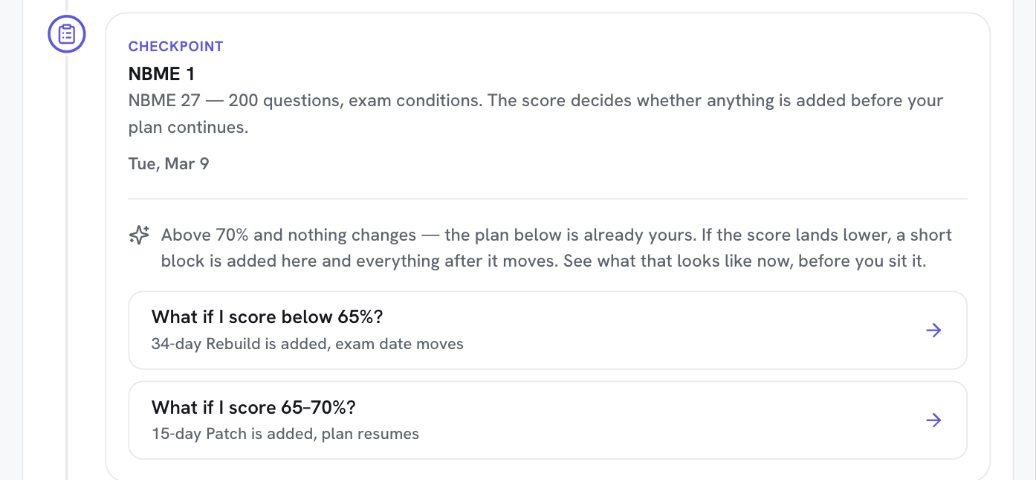
On the Vault schedule, your first NBME (NBME 27) picks 1 of 3 roads, and all 3 are planned before you ever give it. A low score isn't a verdict. It's a known road. Tap the score you just got:
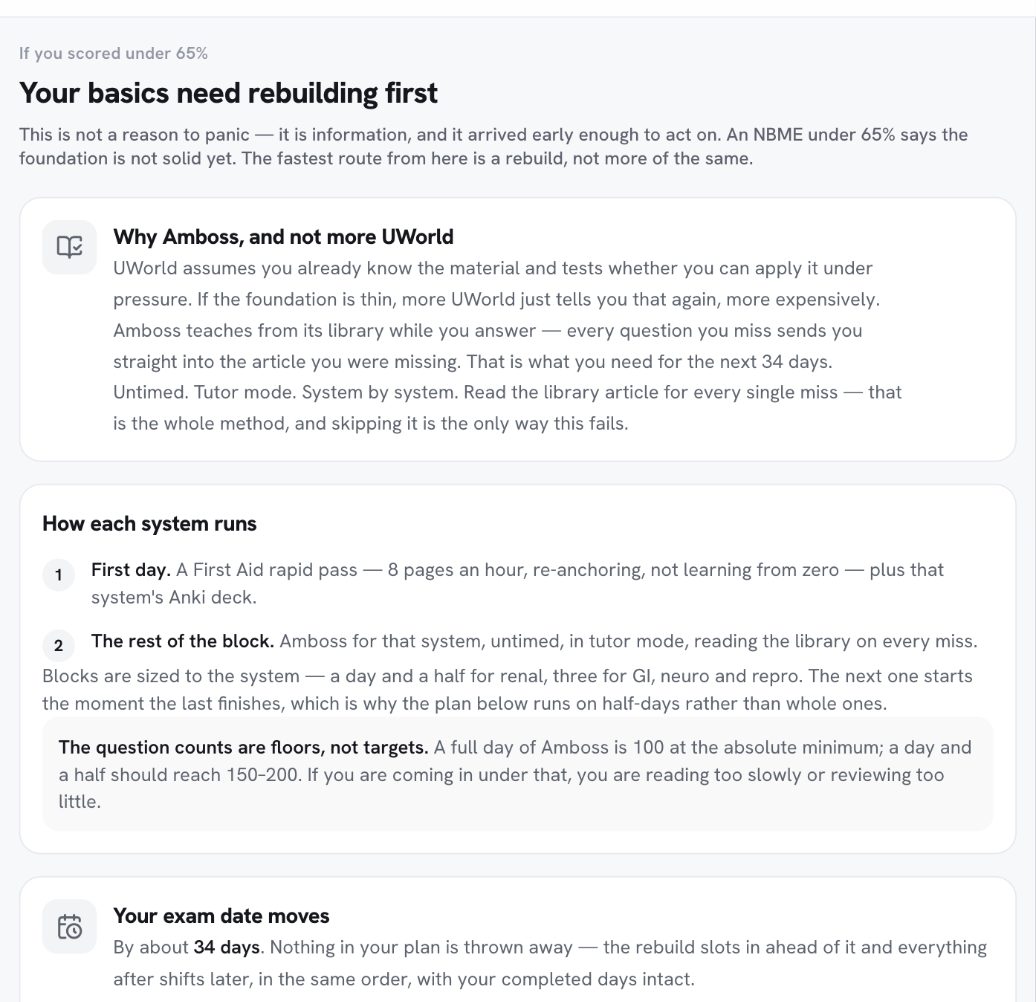
The foundation isn't solid yet, so the schedule adds a Rebuild block and your exam date moves. The plan is re-cut, not abandoned.
The Rebuild runs on FA Foundation AnkiEvery system, in First Aid order, with its First Aid page on every card. Open the deck for the system you're rebuilding.
Open FA Foundation Anki →Read next: Stuck at 62–65%, the guide the Rebuild is built from. And from the NBME order: under 65% on 27 or 28, stop and diagnose. Don't book a date, don't grind another form.
You're close. The schedule adds a 15-day Patch for your weak systems, ending on NBME 29.
Read next: Stuck at 62–65% for the 3 moves that push 65 above 70, and the NBME order for why 29 and 30 are the repair round.
Nothing changes. You carry on to the next checkpoint on the full 33-day ladder. If it felt bad at 71%, it was a feeling, not a score.
Read next: How to score more than 75%. At this level the gap is review quality and pacing, not content.
Want a day-by-day schedule that tells you exactly what to study next? The Vault builds it around your exam date.
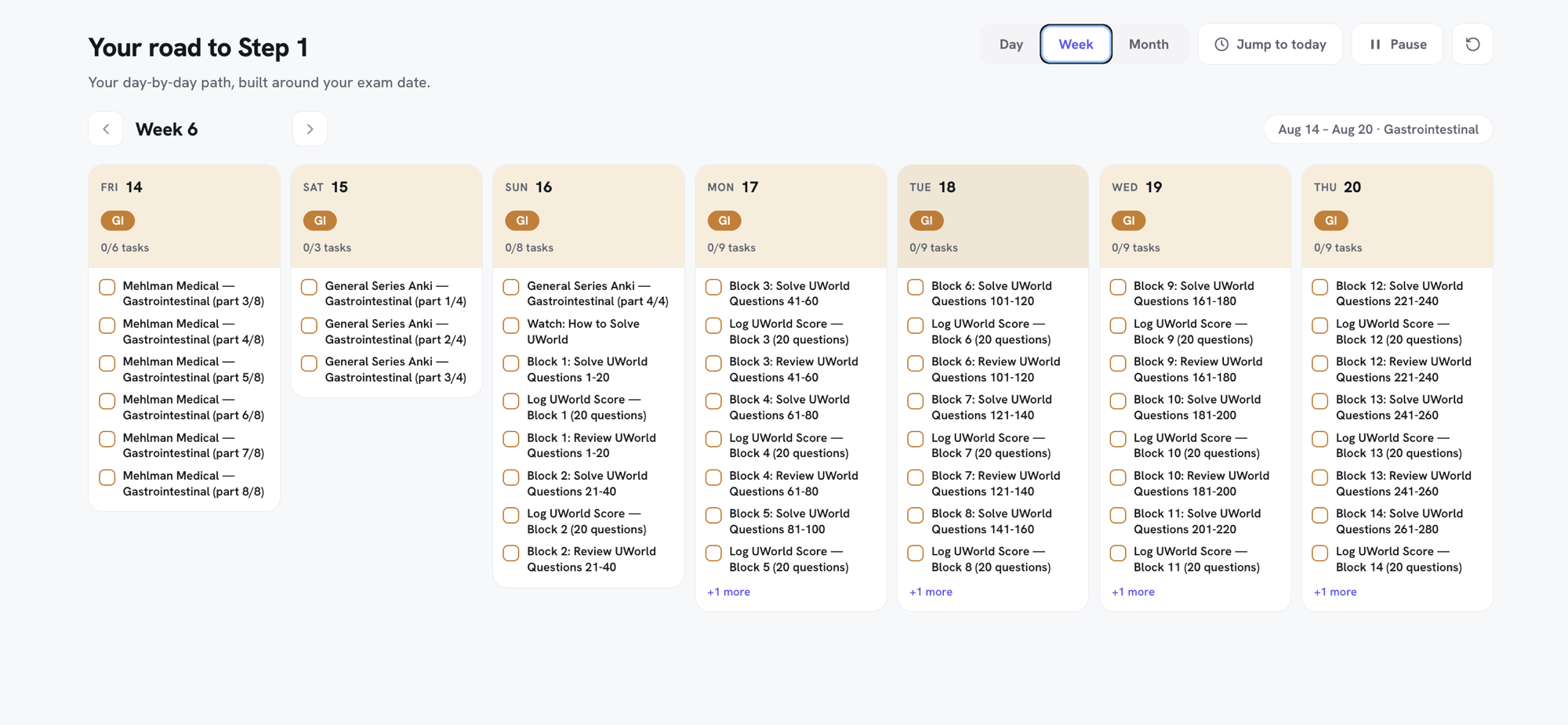 Enter my score and see my road →
Already past NBME 27? The engine branches at NBME 1, and again at NBME 29 if you're on the Patch. On 31 to 33, read the trend, not the form: how to know you're actually ready → The whole road is in Week 1 to exam day.
Just read the NBME section of the Step 2 article, and it'll tell you. Step 2 CK: everything I used to score 254 →
The short version of that sequence: NBME 9 as a baseline, CMS forms 3 to 10, then NBMEs 10 through 16 and the Free 120, every one offline, and a full notes cycle before every single one. A bad form doesn't skip you ahead or push you back. It tells you which notes to cycle before the next one.
And remember the first rule: the trend on NBME 13, 15 and 16 predicts, and on Step 2 CK the Free 120 most of all. If the bad one wasn't one of those, it was training. The week before each form, and the whole ladder: the week before your NBME, Step 2 CK →
Step 2 CK has its own NBME Booster AnkiNBME 9 to 16 and the Free 120 as one-liners, system by system. Run it with your notes cycle before the next form.
Open the Step 2 CK Booster →Want me to look at your scores and your date with you? Book a free 30-minute call →
Look at your kind tally. If you're someone who changes answers, and those changes usually go from correct to incorrect, stop doing that. You have to actively practise not doing it, from the next NBME onwards.
Say you've just given NBME 27. Before the next NBME, do 2 blocks of 20 questions, timed, every day, for the 5 days leading up to it. In every block, practise not changing your answers.
Offline blocks, always: 20 questions in 30 minutes is the pace of the real exam, and the online format (50 in 75 minutes) inflates your score by 4 to 6%. Why offline →
On the Vault schedule, those blocks are already there: NBME 26 offline for the 5 days before NBME 27, and 2 blocks of NBME 28 a day for the 5 days before NBME 29 on the Patch. Run them with this rule.
For Step 2 CK, run the drill on CMS forms or NBME blocks, timed, 20 questions each, so you don't repeat the same mistakes in the main NBME.
The full block method: Taking your first NBME → The next form itself, hour by hour: 24 hours of an NBME day → Out of forms and still in the 60s? All the NBMEs in 6 days →
The NBME Review Protocol — same day, every form.
The NBME MCQ Protocol — when to switch an answer, and when not to.
Week 1 to exam day — the whole road, with what happens at NBME 1.
Stuck at 62–65% — the 3 moves that break a plateau.
The week before your NBME — a tab for every form.
Above 75% — from comfortable to strong.