 VUSMLE Vault←All guides
For IMGs who keep losing marks on NBME questions they actually knew. Step 1 and Step 2 CK.
By Dr. Marish Asudani · Published
Accept that there is no such thing as a silly mistake: every miss is a pattern. Review your NBME the same day and sort every miss into 1 of 5 types. Then never look at the options before you have read the whole stem and thought of your answer. Switch only if a line in the stem rules your answer out, and practise this on NBME blocks or CMS forms before your next full NBME.
Read this before your next formEvery student has a rolodex of silly mistakes. You didn't read the question properly. You missed a word. You knew it and still lost the mark. So you call it a silly mistake.
Here's the turn: if you get good at analyzing your patterns, you can get good at fixing them. And if you get good at fixing patterns, you stop making silly mistakes. Here's how, in 6 steps.
"Silly" means random, and random can't be fixed. A pattern can. The moment you call a miss silly, you stop looking at it. The moment you call it a pattern, you start counting it.
And when you start counting, you'll find the same 2 or 3 habits behind most of your "silly" marks. That's good news: a habit is 1 fix, not 14.
Review your NBME on that day itself. That's what lets you separate the knowledge deficits from the silly mistakes. After 24 hours you no longer remember why you picked the wrong option, and without that, you can't tell which type of mistake it was.
Silly mistakes are not 1 thing. They're many things. First you stratify them, and the way to stratify is the review. Tap each type to see its fix.
You skimmed the stem, missed a line, or answered a question that wasn't asked.
Fix: Step 4. Never look at the options before the whole stem.
You saw an option that looked right and ticked it without reading the rest.
Fix: Step 5. Your answer first, then a proper look at every option.
2 options looked right and you couldn't choose.
Fix: Step 5. If you already have your answer, the other options can't confuse you.
Right first, then wrong. Count how often your changes go from correct to incorrect.
Fix: Step 5's switching rule, and the 5-day drill: 2 timed blocks of 20 a day for the 5 days before your next NBME, practising not changing answers. The drill →
This one isn't silly at all. It's a knowledge deficit.
Fix: read the First Aid page and understand the mechanism, watch the video on that page of the First Aid Guide if it has one, then a targeted UWorld block on it. One-liner in your notebook, filed by system. Before your next form, run that system in the NBME Booster Anki: the way the NBME has already asked it.
Type 5? Run that system in the NBME Booster AnkiEvery topic the NBME has already asked, as one-liners, system by system. Open the system your knowledge deficits keep landing in.
Open NBME Booster Anki →You are never supposed to look at the options without going through the entire question stem first. Read that again.
Tap your exam to see its reading order.
Anki trains the same habit every day. A card never gives you options, so you have to pull the answer out yourself. That is why FA Foundation Anki and the NBME Booster Anki are in every plan I give. 2 decks = a 30-point jump →
Train answer-first recall every dayNo card in either deck shows you options, so you pull every answer out yourself.
FA Foundation Anki →NBME Booster Anki →Once you have already made your diagnosis, you look at the options. When you see your answer there, the other options can't confuse you. And you still read every option properly.
And flag only for 3 reasons: you didn't know it, you're torn between 2, or you think you misread it. Flagging 12 out of 20 is not a strategy.
▶Alec Palmerton · Test-taking tips: from "stuck between 2 answers" to 260+12 minutes on the exact moment Step 5 is about. Full breakdown: the NBME MCQ Protocol, Phase 4 →Practise the MCQ protocol on NBME blocks (Step 1) or CMS forms (Step 2 CK), so you don't repeat the same mistakes in the main NBME. Timed, offline, 20 questions, 30 minutes, with the 1 type from Step 3 that keeps costing you as the thing you watch for in every block. Offline because the online format (50 questions in 75 minutes) inflates your score by 4 to 6% and trains a pace you'll never use.
▶How to solve NBME blocksMy video. The 2 passes inside every block of 20. ▶Action Potential Mentoring · USMLE practice questionsPractice questions with explanations. Run Steps 4 and 5 on every one. YouTube playlist.On the Vault schedule, those blocks are already there before every form: NBME 26 blocks in the dedicated week before NBME 27, and NBME 28, 29, 31 and 33 blocks on the road after it. How to give them offline → · The day itself: 24 hours of an NBME day →
Want a day-by-day schedule that tells you exactly what to study next? The Vault builds it around your exam date.
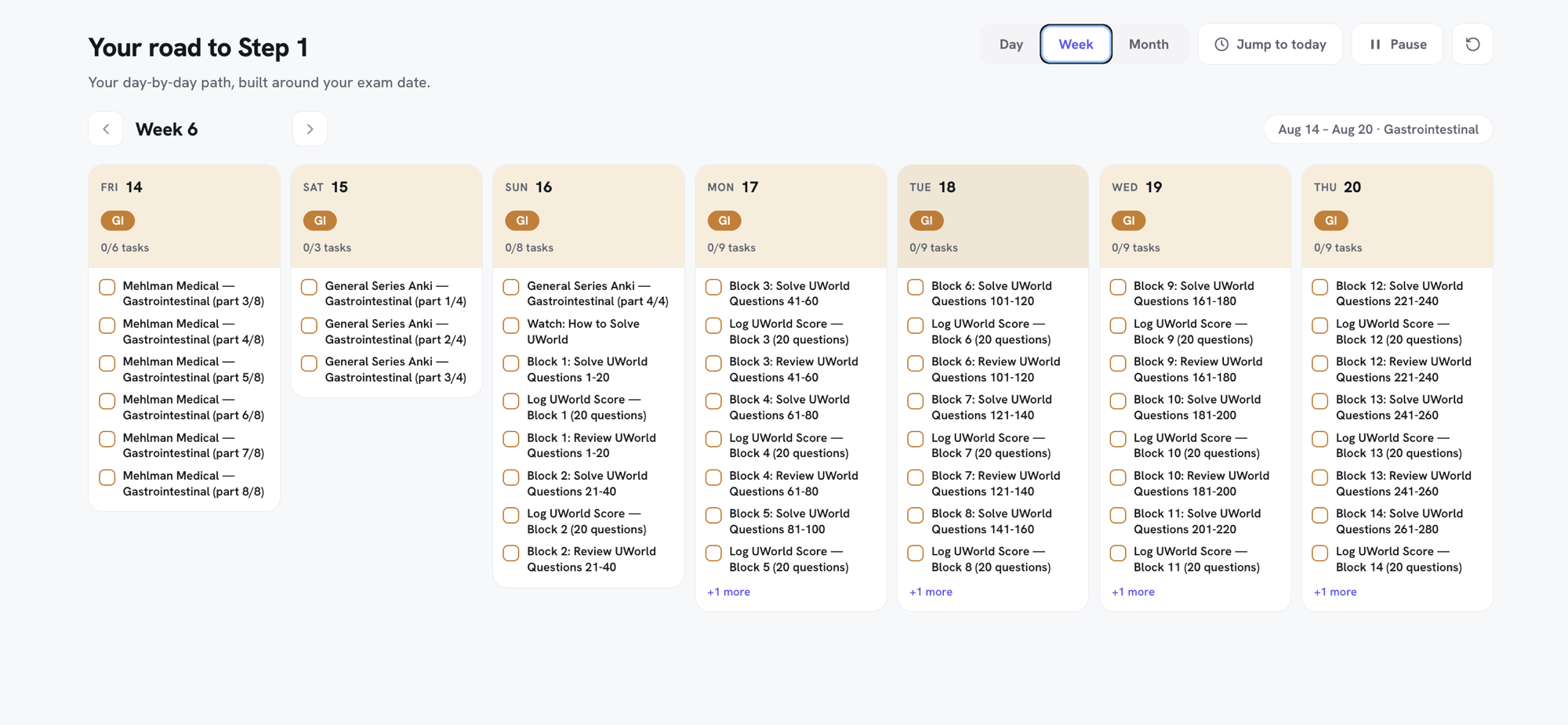 Put my practice blocks on a schedule →
The NBME MCQ Protocol — the 4 phases, every question.
The NBME Review Protocol — same day, every form.
24 hours after a bad NBME — the 5-day answer-changing drill.
NBMEs offline: the complete system
How to score more than 75% — pacing and review at 68%.
The week before your NBME — a tab for every form.