 VUSMLE Vault←All guides
10 out of 10 habits that got an IMG matched in IM, and they get more niche as you go.
By Dr. Marish Asudani · Published
My first habit was always knowing that my aim was to match, not to get a score. I got a 254 on Step 2 CK within 4 to 5 months, before most of my batchmates, because my end goal was the match. The other 9 are things I repeated: I started each Step before the last one went cold, studied in the gaps of every shift, built every schedule backwards from a date, knew tomorrow's tasks every night, put every wrong answer into the 1 First Aid I used for Steps 1, 2 and 3, gave every NBME offline, revised my whole First Aid before every NBME, revised all my previous NBMEs before each new one, and arrived 30 minutes early and pumped myself up before every exam.
Read this firstI graduated MBBS in April 2024, gave Step 2 CK that August, and matched in Internal Medicine in March 2025, with 3 US clinical experiences and zero publications.
I'm not a genius. My first ever UWorld block was 50%. What I had was a set of habits, and the first one decided all the others.
The first habit was always knowing that my aim is to match, not to get a score.
90% of the people I see want to get a 260 and a 270, while they forget that it takes them 1 year to get that score. It's not that useful, because an increased score in 1.5 years just loses you an entire year.
I got a 254 on Step 2 CK within 4 to 5 months, before any of my batchmates and most of my seniors. I was able to do that because my end goal was always to match.
Make sure that your first effort is understanding that you're here to match, not to score well. Good scores are a strategy for matching. Nothing more. Why I'd stop focusing on a 270.
Step 1 was done during internship, before I graduated in April 2024. My Step 2 CK preparation began during internship too, and I gave Step 2 CK in August 2024, 4 months after graduating. Step 3 went in that December, during interview season.
How I did it: I started Step 2 right after Step 1, while my visual memory of First Aid was still fresh, in the same book. The break between Steps is where 18 months quietly disappear: content decays and you pay to relearn it.
My internship and my USMLE prep ran at the same time. I never waited for a clean block: 40 minutes at a time, 6 to 10 times a day, plus a 2 to 3 hour study block after work.
That only worked because everything lived on my phone: UWorld, First Aid and the Sketchy PDFs. Between rounds, waiting on a scan, the 20 minutes nobody counts. How I did Step 1 during internship.
A plan without an exam date is a hobby. Every schedule I ran was built backwards from a date, and the date came before the plan.
Want a day-by-day schedule that tells you exactly what to study next? The Vault builds it around your exam date, for Step 1.
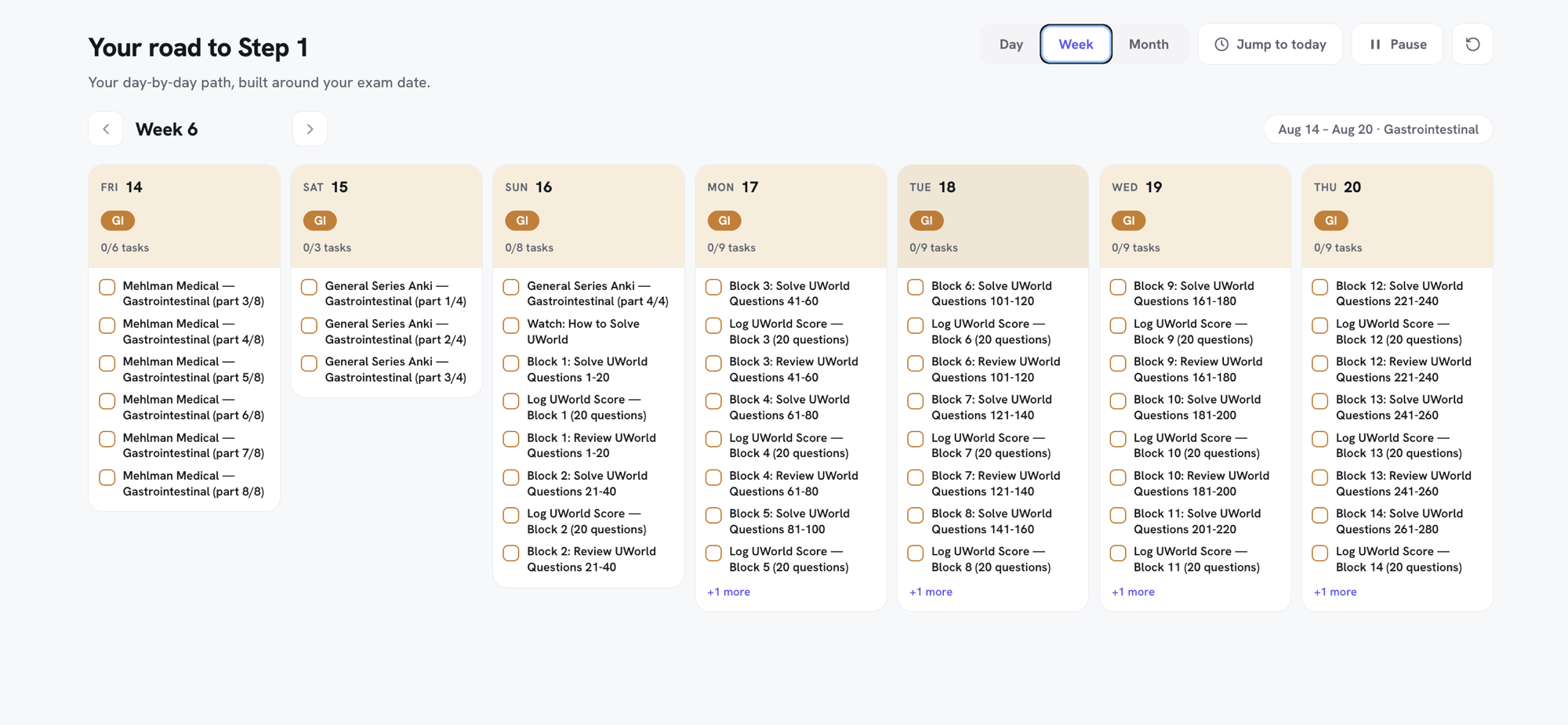
The night before, I knew what tomorrow's tasks were, so I woke up already knowing what to do. On a shift, the 40 minutes between patients go to studying, not to deciding what to study. Or let the Vault schedule write tomorrow's list for you.
The First Aid I used for Step 1 is the book I used for USMLE Steps 1, 2 and 3. For Step 2 CK, I annotated that same book with the clinical layer Step 2 tests on top. Every wrong answer went into it in 1 to 2 lines, never into a separate document.
For Step 1, the First Aid Guide in the Vault is tied to the same pages. How I read First Aid · my Step 2 notes.
Every NBME, on every Step, offline, in timed blocks of 20 at the real exam's pace. The online version gives you 50 questions in 75 minutes. It feels comfortable and inflates your score by 4 to 6%, so you'd plan on a number that was never real. Why NBMEs are always offline.
Before every NBME, I did a full revision of my notes, which was my First Aid book. Every single time. On Step 2 CK, that notes cycle is worth 5 to 10 points, it costs nothing but discipline, and almost nobody does it.
Sometimes it got irritating, which is why I built the FA Foundation Anki: the whole of First Aid, page by page, as cards.
Open the FA Foundation AnkiThe whole of First Aid, page by page, as cards. The notes cycle, without the irritation.
Open the deck →Before I gave the next NBME, I did a full-cycle revision of all of the previous ones. I did this during every one of my Steps, so I built an entire Anki deck out of it: the NBME Booster Anki.
The forms are already published. Revising every one before the next is how the patterns stick. What's in each deck.
Open the NBME Booster AnkiStep 1: NBME 20 to 34 and the Free 120, system by system. Opens straight into the deck.
Open the deck →Before every Step exam, I reached the centre 30 minutes early and pumped myself up to high confidence and high concentration. Here were some of my clips: a 50 to 60 second Kobe Bryant motivation clip, a Jon Jones motivation clip.
Same for interviews: before every interview, I always prepared and warmed up. With 3 interviews, every one had to convert. The Ace Interview Program.
▶Dr Pannu's Interview Prep That helped her MATCH!My channel, UsmleMatch. Interview prep, from a student who matched.None of these 10 is a resource. Every one is something I did again and again, until it stopped needing motivation.
Stop focusing on a 270 — habit 1, in full.
MBBS to Match — the whole timeline.
All 3 Steps in under 12 months — no break between Steps.
Step 2 CK: the 6 resources — for the 254.
10 habits behind my 254 — the Step 2 CK version of this page.