 VUSMLE Vault←All guides
20 weeks, while working. None of these habits is "study harder". All of them are things you can start tomorrow.
By Dr. Marish Asudani · Published
Pick 1 set of notes on day 1 and never switch. Put every wrong answer back into those notes in 1 or 2 lines. Practise your exam-day glucose routine in every NBME. Do a full notes cycle before every NBME. Know tomorrow's tasks tonight and keep a hard date. Run the MCQ protocol on every question until it's automatic. Review every NBME the same day. Screenshot every unknown by system. And keep your deck and videos on your phone. My NBMEs went 222, 245, 233, then about 238, and I scored 254 on the real exam.
Read this firstMy Step 2 NBMEs were not a straight line. The drop came right after my best form.
Before my exam, my last form was NBME 14, at 237, 238 or 239, roughly. Then I scored a 254. What carried me through those dips wasn't motivation. It was 10 habits I ran every day.
The only predictive tests I have found on Step 2 CK are NBME 13, NBME 15 and the Free 120. Read the trend across NBME 13, 15 and 16, and then the Free 120, which is the most predictive of all. What I have seen: 80%+ on the Free 120 = a good chance of 250+. What I did after the 233 →
Annotated First Aid for 250, Inner Circle for 260+. I picked mine and never switched, so by the end I was revising notes that felt like my own handwriting.
Every wrong UWorld answer, opened to that exact topic, corrected in 1 or 2 lines. Without that step, a block is half the work.
20 questions, 3 deep breaths, 20 questions, then a short break with simple sugar: ½ a bottle of Gatorade, Tang or Glucon-D, or ½ a bar of chocolate. I ran that in every NBME, so exam day felt normal. 24 hours before Step 2 CK → · The Step 1 exam-day routine →
The rule that carried my Step 2. Worth 5 to 10 points, costs nothing but discipline, and almost nobody does it.
You stay consistent by understanding exactly what to do tomorrow. And you need a structure, because to stay consistent you need to consistently see progress. The accountability system →
Want a day-by-day schedule that tells you exactly what to study next? The Vault builds it around your exam date. It's built for Step 1, so if Step 1 is still ahead of you, start there.
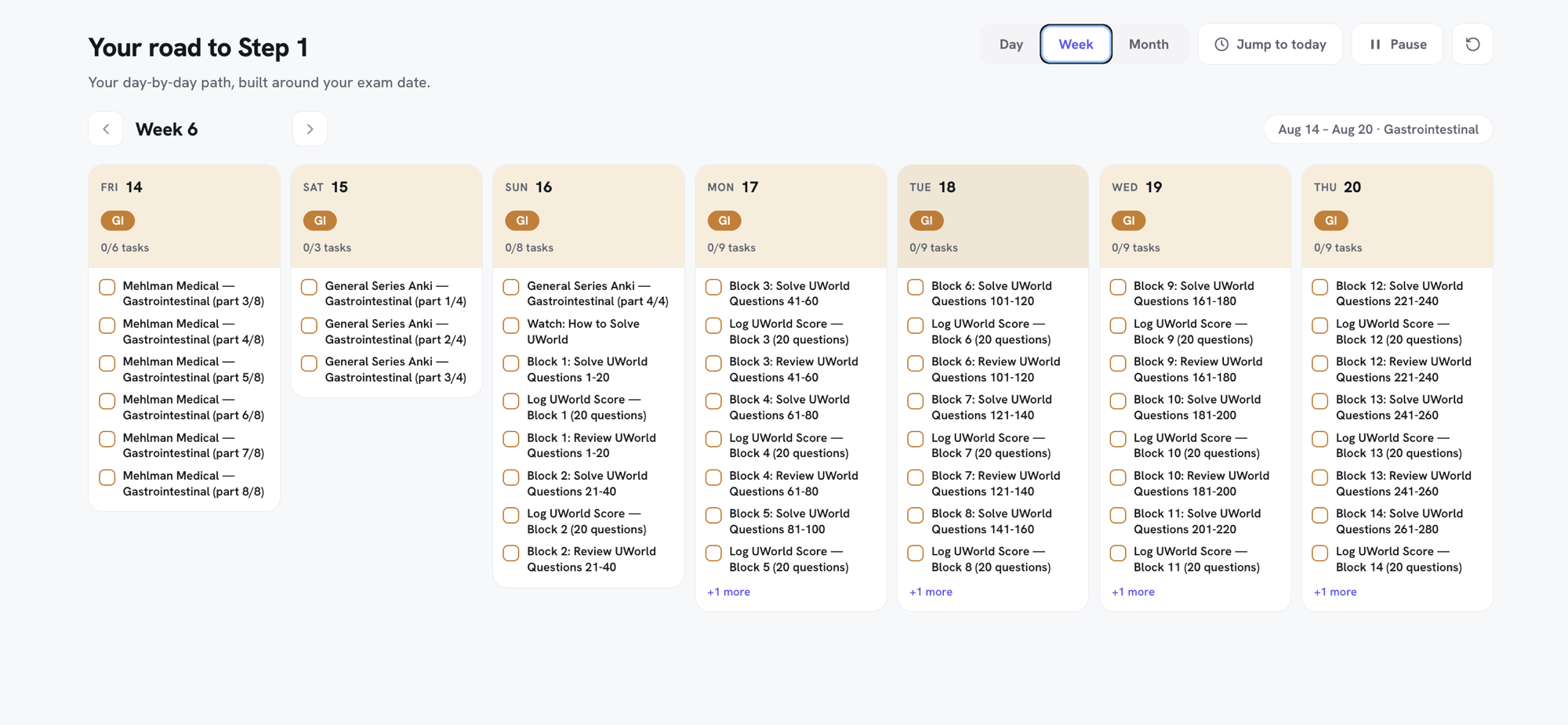
Always have a hard date in your mind. Mine was August 2024, 4 months after graduating.
Stimulus first: labs, a derm image or a simple X-ray, then straight to the last line. Diagnosis and management before you read the options. Switch an answer only when a hard-coded line in the stem rules an option in or out. The NBME MCQ Protocol →
Check which questions are wrong without seeing the answers, cover the options, decide practice gap or knowledge deficit, and turn every incorrect into a one-liner filed by system. The NBME Review Protocol →
And every NBME was taken offline, in timed blocks at the real exam's pace, about 90 seconds a question. Online forms are more spacious and inflate your score, and a number that was never real is useless to review. Why NBMEs are always offline →
AJmonics and AMBOSS: every question or concept I didn't know went into a folder for that system. In the last week, those folders were 1 of my 3 revision resources.
Have the Anki deck on your phone. Buy a pair of Bluetooth earphones so you can watch videos anywhere. For Step 2 that means the Step 2 CK NBME Booster Anki in the Vault (NBME 9 to 16 and the Free 120), plus Mehlman, Dr. High Yield and AJmonics in your pocket. 10 Step 2 CK videos to start with →
▶Mehlman · Internal medicinePlaylist. 1 system a day in consolidation. ▶Dr. High Yield · Internal MedicinePlaylist. A fast pass, especially when your score is stuck. ▶AJmonics · COMPLETE Step 2 ReviewPlaylist. About 200 questions per system, after NBME 12.The Step 2 CK NBME Booster Anki, on your phoneRuns in your phone's browser, no app needed. NBME 9 to 16 and the Free 120, system by system.
Open the deck →Step 2 CK: the 6 resources — what the habits run on.
6 steps to more than 250 — the prep, in order.
24 hours after a bad NBME — what I did after the 233.
The accountability system — the Step 1 version.