How do I study the cardiovascular system for Step 1 in just 1 week?
Do cardio in 1 fixed order over 7 days, if you have 10–12 hours a day. Day 1: the 18 organisms and 3 drug groups. Day 2 to Day 3 morning: active reading of First Aid pp. 284–328 with the MCQs. Then the Mehlman cardio playlist, then the FA Foundation Anki cardio deck. Days 5–7: UWorld cardio, system-wise, with every miss reviewed in First Aid.
Read this first
This is only for you if you have roughly 10–12 hours a day for studying, and you're an intern or a graduate.
Working, or studying 5–8 hours a day? Keep the same order and stretch the days. Step 1 while working →
Cardiovascular is daunting for 1 reason: students don't do it in a structured way. They open UWorld, score 40%, and decide they are bad at cardio. They are not. They are in the wrong order.
Structure fixes that. Every step below hits the same 46 pages from a different angle, so when you open UWorld on Day 5, it's your 4th pass of those pages, not your 1st.
Day 1 is the one people skip, and it's the one that matters most. Doing the cardio pharmacology from videos takes half a day, 5 to 6 hours. If you invest this time in doing cardiovascular properly, and the pharmacology, you will become invincible, and there is nothing on this planet that can stop you.
And do it last. Start with the easy systems (renal, respiratory, GI), finish every other system, and only then open cardio. Never start your prep with cardiovascular. It's the hardest system, and it stays freshest when it comes last.
Start here · before page 1
Cardiovascular: micro and pharm first
Cardio starts with its own organisms and drugs: 18 organisms and 3 drug groups. Day 1 below does both, hour by hour. These are the full guides for each one.
Cardiovascular is the last system. If you haven't done the others yet, don't start here. Start with renal, then respiratory and GI, and come back to cardio when every other system is finished. Tap a system to open its guide.
9:15 AM–1 PMMicro: the 18 cardio organisms, WRWRT. Watch, recall, watch the gaps, read the Sketchy PDF.
2–6 PMPharm: antiarrhythmics Classes I–IV and digoxin (Sketchy). Each video twice, back to back.
7–9 PMPharm: lipid-lowering agents (Dirty Medicine), twice. Recommended, not required: the 3 Dirty Medicine lipid metabolism videos first.
9–10 PMRead the cardio drugs in the High-Yield Pharmacology PDF and highlight what didn't stick. Then test: the First Aid Guide MCQs for today's organisms and the cardio pharmacology.
Day 2 · Active readingFirst Aid Guide, page by page, MCQs on every page
9:30 AM–1 PMBlocks 9–10 (Qs 161–200): solve both in tutor mode, log each score, then review every bookmark in First Aid.
2–6 PMFA Foundation Anki revision: the cardio cards you missed on Day 4. Then check the 3 finish rules below.
Same pages, 5 angles. Every step hits the same 46 First Aid pages from a different direction. That's why the order matters more than the resource. The method behind every system →
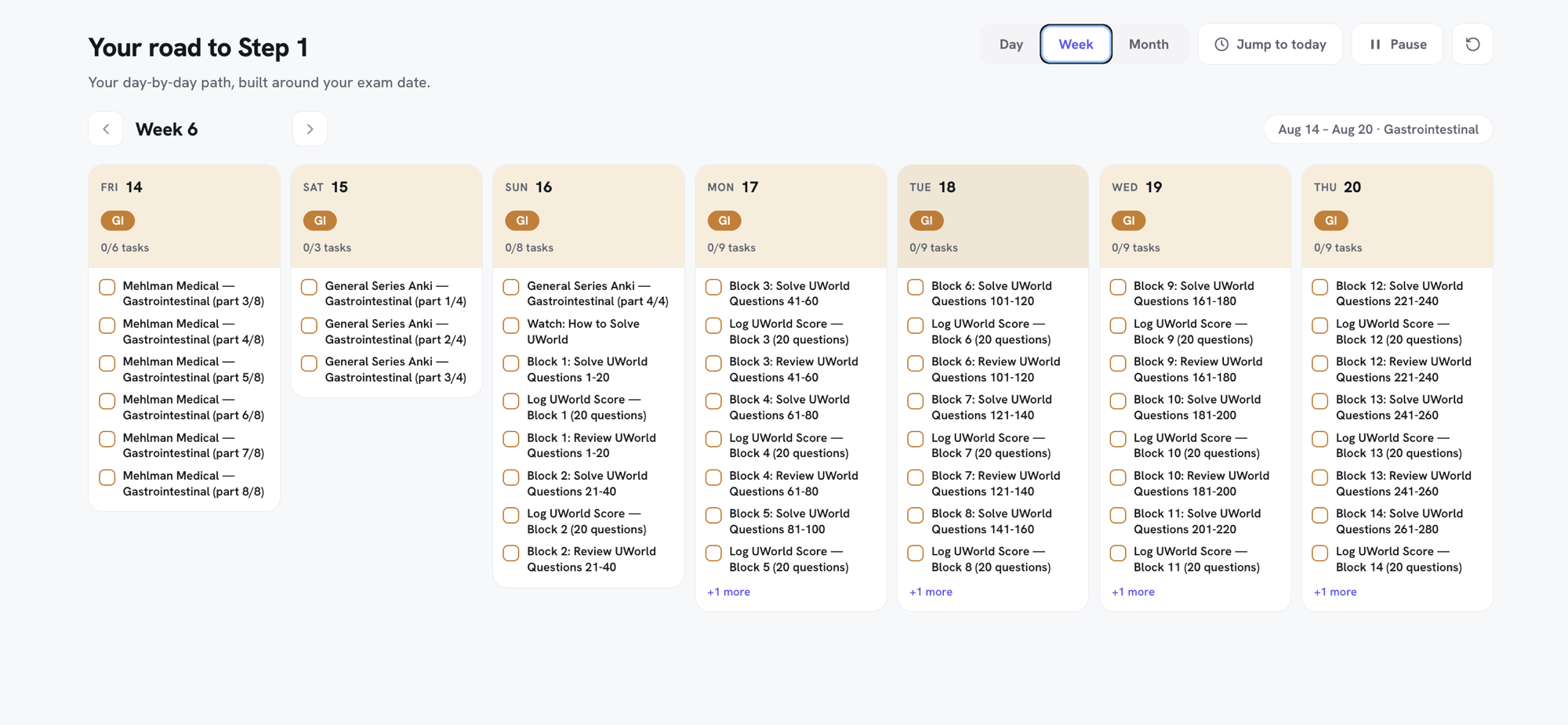
Want a day-by-day schedule that tells you exactly what to study next? The Vault builds it around your exam date.
Open the First Aid Guide → Cardiovascular in the Vault (what the First Aid Guide is). You will see 2 pills: Micro and Pharm. Each opens the exact cardio list, and nothing else. Do both today: micro in the morning, pharm in the afternoon.
Cardiovascular in the First Aid Guide on usmlevault.com: its First Aid pages, MCQ count, the micro and pharm pills it has, and the How to do Cardiovascular video.
Micro · 18 organisms · the WRWRT method.Watch the sketch at 1x with no notes → Recall the whole story in your head, in order → Watch again only the gaps at 1.5–1.75x → Read the Sketchy PDF for that organism → Test with the First Aid Guide MCQs for that organism.
Pharm · the FWRT method.Find the resource (already mapped for you, below) → Watch each video twice, back to back → Read the High-Yield Pharmacology PDF after all of them, and highlight only what did not survive → Test in the First Aid Guide → Cardiac → Pharmacology.
"Doing the pharmacology section from videos is extremely important. It will take you half a day, 5 to 6 hours, to understand them."
Recommended, not required: the 3 Dirty Medicine lipid metabolism videos, watched before the lipid-lowering drugs. The drugs make far more sense after them.
Never done Sketchy? Do the same list from First Aid and the First Aid Guide alone. The list does not change, only the source. Every system's micro and pharm →
Why micro and pharm first: when you reach infective endocarditis on p. 318 and the antiarrhythmics on pp. 326–328, you meet them as old friends, not new facts.
3
Before Day 2What the First Aid Guide is, and why you read it
First Aid was written to remind you, not to teach you. Every line assumes you already understand it. That is why IMGs spend 3 hours on 1 page, Google half of it, and still remember nothing a week later.
The First Aid Guide on usmlevault.com puts the teaching back into the page. Every cardiovascular page (pp. 284–328) has the same 5 parts:
Focus On: what on this page is high-yield, and what to skip.
Concept Walkthrough: the page in the order you should think about it.
ELI5: each heading in plain English, with the trap the exam sets. What ELI5 is →
How is this tested?: Common Confusion → Core Concept → The Trap → Your Approach. See a real page →
Test Yourself MCQs on that exact page: 234 across cardiovascular (as of October 2026), with a Rule-out button so you practise elimination the way UWorld makes you.
Example: p. 284, Heart morphogenesis.
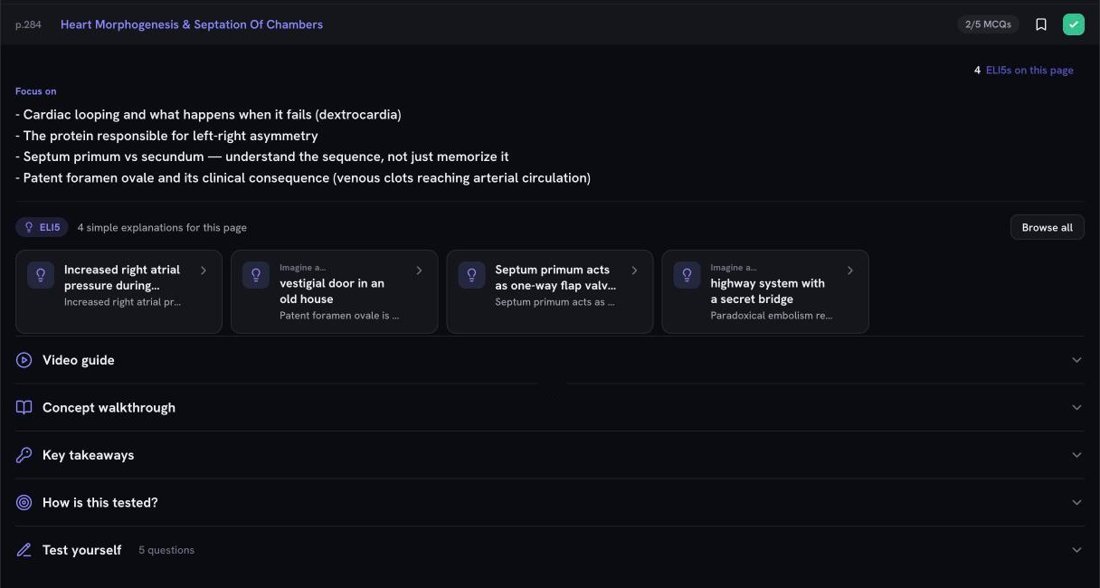
Focus On tells you what matters on this page: cardiac looping and what happens when it fails (dextrocardia), the protein responsible for left-right asymmetry, septum primum vs secundum as a sequence rather than a list, and patent foramen ovale with its clinical consequence.
First Aid p. 284 (Heart morphogenesis and septation) in the First Aid Guide: Focus On, the ELI5s, the video guide, Concept walkthrough, Key takeaways, How is this tested? and Test yourself.
Why it works: you understand the page, then prove it with MCQs in the same minute. 60–70% of UWorld traces straight back to First Aid lines, so a page you truly understood is a UWorld question you already own.
Open Cardiovascular in the First Aid GuideFirst Aid pp. 284–328, page by page: Focus On, ELI5 and the MCQs on every page. Opens straight into cardiovascular.
Day 2 → Day 3 morningActive reading: First Aid pp. 284–328 + p. 478
Active reading means that for every page you explain it, understand it, and do it. The MCQs are part of the reading. That is what makes it active. You do not move to the next page until all 3 are done.
Read Focus On for the page. Now you know what matters.
Run the Concept Walkthrough and the ELI5s. Explain each heading back in your own words, out loud. If you cannot say it, you have not understood it.
Read the actual First Aid page. It should now read like a summary of something you already know.
Solve the Test Yourself MCQs. Any miss → back to that heading before you turn the page.
Pace: 10–12 minutes a page, 4–6 pages an hour. Do not memorise. Understanding is the only job on these pages. Memory is the Anki step's job.
The vasculitides are on p. 478 in the book, but the First Aid Guide reads them inside cardio pathology. Do them with cardio.
Day 2 · pp. 284–314 · embryology to arrhythmias (31 pages)
Day 3 afternoon → Day 4 morningActive application: Mehlman Medical
You understand cardio. Now you learn how the exam asks it. Mehlman's videos take each high-yield topic and show you which clue rules an answer in, which one rules it out, and how to get from the stem to the answer.
Videos, not PDFs. The value is the reasoning, and the PDFs do not have it.
The full cardio playlist, in order. Not random clips. Watch the how-to video below first.
Pause before he answers, and answer it yourself. Anything that exposes a gap → open that First Aid Guide page and fix it the same day.
Short on time? Sort the playlist by date and watch the last 3 years first.
Why: active reading gave you the facts. Active application turns facts into decisions, and a decision is the only thing a UWorld question asks for. How to use Mehlman →
What it is: the FA Foundation Anki deck is First Aid, page by page. 1 high-yield point per card, and the First Aid page number is on every card. The Cardiovascular deck is 198 cards (as of October 2026).
How to use it: run the whole cardio deck in this half day. Answer before you flip. If you hesitate, open that page in the First Aid Guide, read the line plus a couple of lines above and below, then go back to the card.
Why: this is your third full pass of cardio First Aid, and the first one done without the page in front of you. Recognising a line and pulling it out of memory are different skills, and UWorld tests the second one.
Example card · FA Foundation Anki · CardiovascularDuring fetal circulation, a thin flap between the atria allows right-to-left blood flow. At birth, rising left atrial pressure pushes this flap shut.
Which embryologic septum forms this one-way valve?
Septum primum: it grows first, and becomes the thin flap covering the foramen ovale.
Run the FA Foundation Anki · Cardiovascular deck198 cards (as of October 2026), First Aid page by page, with the page number on every card. Opens straight into the deck.
Now you open UWorld. You are not meeting cardio here. You are proving you already own it.
UWorld settings
QuestionsUnused
SubjectsAll
SystemsCardiovascular only
ModeTutor, untimed
Block20 questions
Solve. Do 2 blocks of 20. Bookmark every question you got wrong and every one you got right by guessing.
Review in First Aid. For each bookmark, find the exact First Aid line it came from, highlight it, and read a couple of lines around it. 5–6 minutes a question, no more. Then the next 2 blocks.
Target:65% or above. If your last 2 blocks are under 60%, go back to the Mehlman videos for those topics, then the First Aid pages behind them.
Cardiovascular has about 200 UWorld questions on the USMLE Vault schedule: 10 blocks, over Days 5–7 (the plan above). Keep going until the 3 checks below are true, even if that takes an extra morning.
Cardiovascular is finished when every cardio UWorld question is attempted, every miss is traced to its First Aid page, and your last 2 blocks held above 65%. Not when a date passes. When is a system actually finished? →
Later, for your NBMEs: NBME Booster Anki · CardiovascularThe cardiovascular questions from retired NBME forms 20 to 34 and the Free 120, as cards. Not for now: open it when your NBME phase starts. What the Booster is →
Short on time? The Vault schedule's note for cardio UWorld: do Physiology, Anatomy, Pharmacology and Pathophysiology, and skip the Pathology subject. The same note says cardio UWorld is optional if you are short on time.
What not to do
Do not open UWorld on Day 1. You will score 40%, decide you are bad at cardio, and you are simply in the wrong order.
Do not read First Aid to memorise it. The reading days are for understanding. Memory is the Anki step's job.
Do not skip the page MCQs. If you cannot answer them, you read the page. You did not learn it.
Do not split cardio across weeks. 7 days in a row. A half-done system behaves like an undone one.
Do not save cardio pharm for later. The drug pages (pp. 321–328) are the last thing you read. If the antiarrhythmics are new there, Day 1 was skipped.
Let the schedule place cardio for you.
Enter your exam date and your hours. The schedule builds every system, day by day, with the right pages on each day.

 Build my schedule →