Do biochem nutrition first, 1 day, First Aid pp. 63–70. Then 7 days: the 24 GI organisms, active reading of First Aid pp. 364–408 with the MCQs, the Mehlman GI playlist, the FA Foundation Anki GI deck, then UWorld GI on Days 5–7.
Read this first
This is only for you if you have roughly 10–12 hours a day for studying, and you're an intern or a graduate.
Working, or studying 5–8 hours a day? Keep the same order and stretch the days. Step 1 while working →
GI goes wrong when people skip the small piece that comes right before it: nutrition. Vitamins, minerals, deficiencies and absorption. GI keeps coming back to them, from B12 and the terminal ileum to the fat-soluble vitamins you lose in fat malabsorption.
Nutrition first, then GI. Skip that 1 day and every vitamin page in GI reads like new material.
Start here · before page 1
GI: micro and pharm first
GI starts with its own organisms: 24 organisms. GI has no Pharm pill, because the drug map does not split out GI drugs, so its pharm is a check of the High-Yield Pharmacology PDF on Day 1 and the drug pages (pp. 405–408) on Day 3. These are the full guides.
GI is the 3rd system, after renal and respiratory. Those 3 are the easy systems: do them first, and don't skip them. Biochem nutrition sits right before GI, and cardio comes last. Tap a system to open its guide.
Biochem is never a block of its own: each piece sits right before the system that needs it. The whole method, once: how to study any system →
1
1 day before Day 1Do nutrition first
Biochem nutrition is First Aid pp. 63–70, and it gets 1 day of its own, right before GI, not counted in the 7. Do it by active reading in the First Aid Guide, the same way you'll do GI: Focus On, the explanation, then the MCQs on each page.
Nutrition · pp. 63–70 · 1 day
63–65Essential fatty acids, the vitamins overview, vitamin A, B1, B2, B3, B5
66–68B6, biotin, folate, B12, vitamin C, vitamin D, vitamin E
Why right before GI: vitamin absorption and the deficiency states present through the GI tract. Read them the day before and the absorption page (p. 381) and the malabsorption page (p. 388) read like a review.
9:30 AM–1 PMBlocks 13–14 (Qs 241–280): solve both in tutor mode, log each score, then review every bookmark in First Aid.
2–6 PMBlocks 15–16 (Qs 281–320): solve both in tutor mode, log each score, then review every bookmark in First Aid.
7–10 PMFA Foundation Anki revision: the GI cards you missed on Day 4. Then check the 3 finish rules below.
Same pages, 5 angles. Micro, then active reading, then active application, then active recall, then UWorld. Every step hits the same 45 First Aid pages from a different direction. The method behind every system →
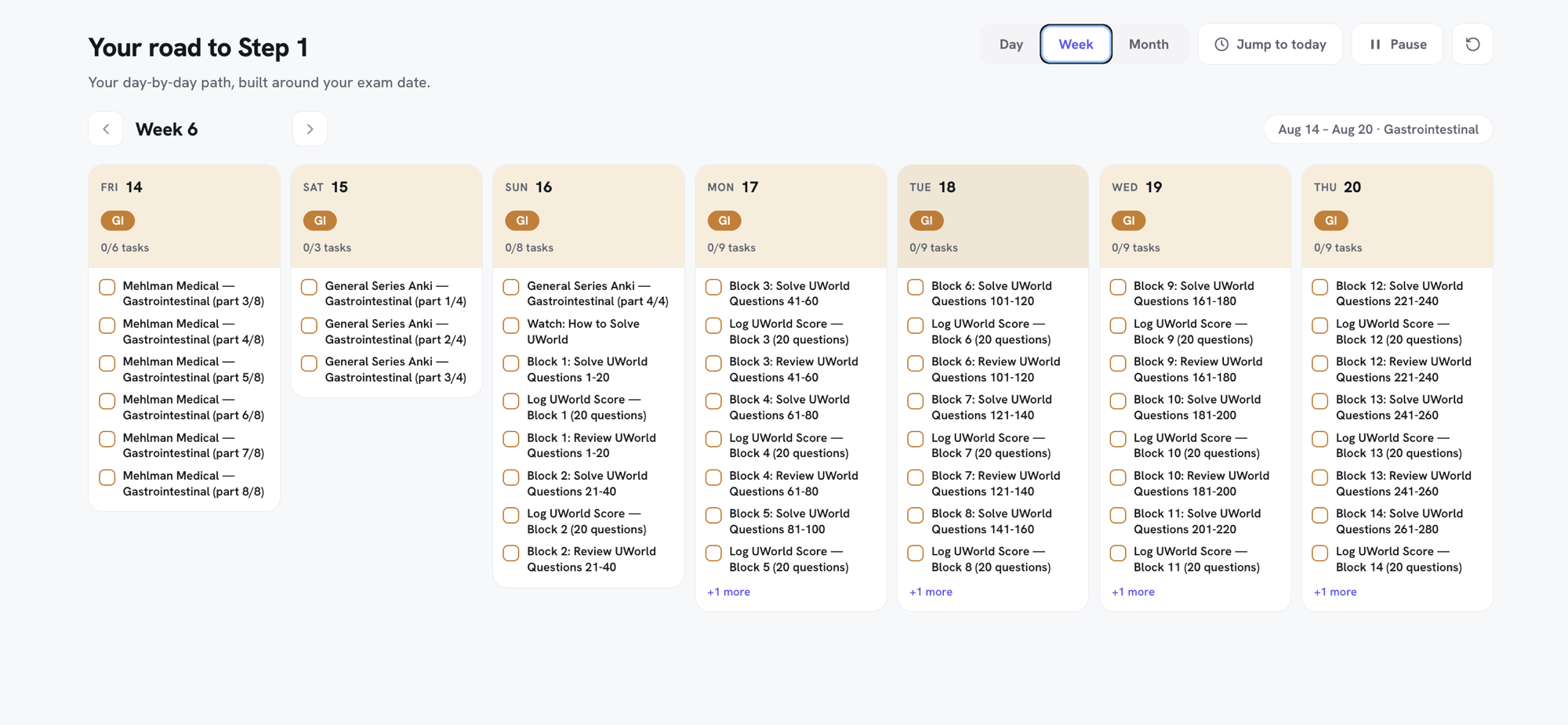
Want a day-by-day schedule that tells you exactly what to study next? The Vault builds it around your exam date.
Gastrointestinal in the First Aid Guide on usmlevault.com: its First Aid pages, MCQ count, the micro and pharm pills it has, and the How to do Gastrointestinal video.
Micro · 24 organisms · the WRWRT method.Watch the sketch at 1x with no notes → Recall the whole story in your head, in order → Watch again only the gaps at 1.5–1.75x → Read the Sketchy PDF for that organism → Test with the First Aid Guide MCQs for that organism.
Pharm: GI has no Pharm pill, because the drug map does not split out gi drugs. Before you start reading, open the High-Yield Pharmacology PDF and look for any gi drugs. If there are notes, do them next to the drug pages (pp. 405–408) when you reach them, not saved for later. The drugs make more sense next to the disease.
Never done Sketchy? Do the same list from First Aid and the First Aid Guide alone. The list does not change, only the source. Every system's micro and pharm →
Why micro first: when you reach the diarrhoeas, peptic ulcer disease on p. 387 and the hepatitis pages, H. pylori, C. difficile and the hepatitis viruses are old friends, not new facts.
4
Before Day 2What the First Aid Guide is, and why you read it
First Aid was written to remind you, not to teach you. Every line assumes you already understand it. That is why IMGs spend 3 hours on 1 page, Google half of it, and still remember nothing a week later.
The First Aid Guide on usmlevault.com puts the teaching back into the page. Every gastrointestinal page (pp. 364–408) has the same 5 parts:
Focus On: what on this page is high-yield, and what to skip.
Concept Walkthrough: the page in the order you should think about it.
ELI5: each heading in plain English, with the trap the exam sets. What ELI5 is →
How is this tested?: Common Confusion → Core Concept → The Trap → Your Approach. See a real page →
Test Yourself MCQs on that exact page: 246 across gastrointestinal (as of October 2026), with a Rule-out button so you practise elimination the way UWorld makes you.
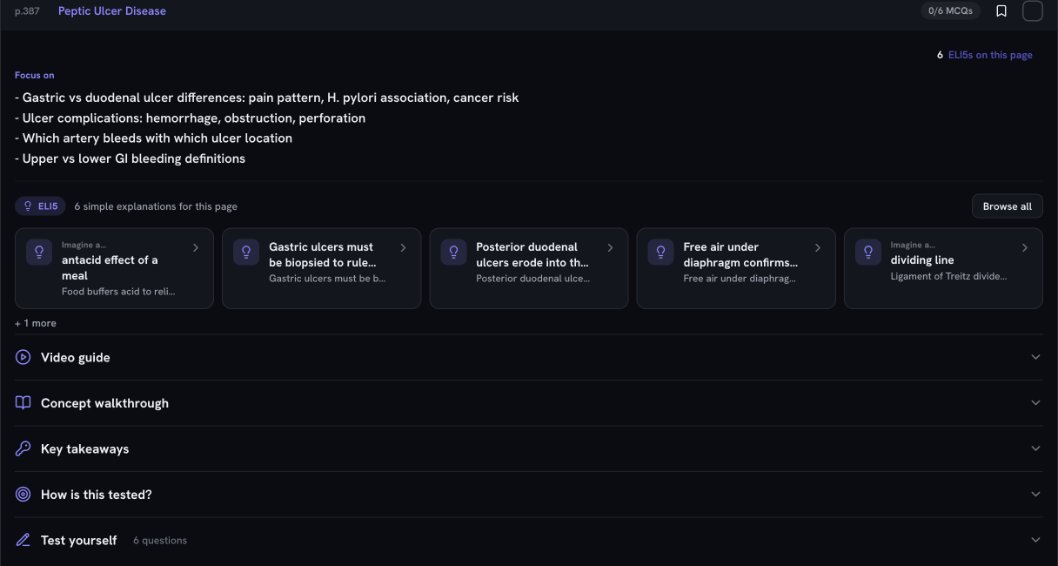
Example: p. 387, Peptic ulcer disease.
Focus On tells you what matters on this page: gastric vs duodenal ulcer (pain pattern, H. pylori association, cancer risk), the ulcer complications (haemorrhage, obstruction, perforation), which artery bleeds with which ulcer location, and upper vs lower GI bleeding.
First Aid p. 387 (Peptic ulcer disease) in the First Aid Guide: Focus On, the ELI5s, the video guide, Concept walkthrough, Key takeaways, How is this tested? and Test yourself.
Why it works: you understand the page, then prove it with MCQs in the same minute. 60–70% of UWorld traces straight back to First Aid lines, so a page you truly understood is a UWorld question you already own.
Open GI in the First Aid GuideFirst Aid pp. 364–408, page by page: Focus On, ELI5 and the MCQs on every page. Opens straight into GI.
Day 2 → Day 3 morningActive reading: First Aid pp. 364–408
Active reading means that for every page you explain it, understand it, and do it. The MCQs are part of the reading. That is what makes it active. You do not move to the next page until all 3 are done.
Read Focus On for the page. Now you know what matters.
Run the Concept Walkthrough and the ELI5s. Explain each heading back in your own words, out loud. If you cannot say it, you have not understood it.
Read the actual First Aid page. It should now read like a summary of something you already know.
Solve the Test Yourself MCQs. Any miss → back to that heading before you turn the page.
Pace: 10–12 minutes a page, 4–6 pages an hour. Do not memorise. Understanding is the only job on these pages. Memory is the Anki step's job.
Day 2 · pp. 364–393 · embryology to bowel disease (30 pages)
364–366Tongue development, GI embryology, ventral wall defects, TEF, pyloric stenosis
367–373Retroperitoneal structures, ligaments, GI histology, blood supply, portosystemic anastomoses, pectinate line
Day 3 afternoon → Day 4 morningActive application: Mehlman Medical
You understand GI. Now you learn how the exam asks it. Mehlman's videos take each high-yield topic and show you which clue rules an answer in, which one rules it out, and how to get from the stem to the answer.
Videos, not PDFs. The value is the reasoning, and the PDFs do not have it.
The full GI playlist, in order. Not random clips. Watch the how-to video below first.
Pause before he answers, and answer it yourself. Anything that exposes a gap → open that First Aid Guide page and fix it the same day.
Short on time? Sort the playlist by date and watch the last 3 years first.
Why: active reading gave you the facts. Active application turns facts into decisions, and a decision is the only thing a UWorld question asks for. How to use Mehlman →
7
Day 4 afternoonActive recall: FA Foundation Anki
What it is: the FA Foundation Anki deck is First Aid, page by page. 1 high-yield point per card, and the First Aid page number is on every card. The Gastrointestinal deck is 194 cards (as of October 2026).
How to use it: run the whole GI deck in this half day. Answer before you flip. If you hesitate, open that page in the First Aid Guide, read the line plus a couple of lines above and below, then go back to the card.
Why: this is your third full pass of GI First Aid, and the first one done without the page in front of you. Recognising a line and pulling it out of memory are different skills, and UWorld tests the second one.
Example card · FA Foundation Anki · GastrointestinalA patient with suspected gastrinoma has a provocative test. A hormone is injected IV. It would normally suppress gastrin, but in this patient gastrin rises.
Which hormone was injected?
Secretin. It normally inhibits gastrin release from G cells, but gastrinoma cells increase gastrin in response to it.
Run the FA Foundation Anki · GI deck194 cards (as of October 2026), First Aid page by page, with the page number on every card. Opens straight into the deck.
Now you open UWorld. You are not meeting GI here. You are proving you already own it.
UWorld settings
QuestionsUnused
SubjectsAll
SystemsGastrointestinal only
ModeTutor, untimed
Block20 questions
Solve. Do 2 blocks of 20. Bookmark every question you got wrong and every one you got right by guessing.
Review in First Aid. For each bookmark, find the exact First Aid line it came from, highlight it, and read a couple of lines around it. 5–6 minutes a question, no more. Then the next 2 blocks.
Target:65% or above. If your last 2 blocks are under 60%, go back to the Mehlman videos for those topics, then the First Aid pages behind them.
Gastrointestinal has about 320 UWorld questions on the USMLE Vault schedule. That is 16 blocks: 6 on Day 5, 6 on Day 6 and 4 on Day 7 (the plan above). Keep going until the 3 checks below are true.
Gastrointestinal is finished when every GI UWorld question is attempted, every miss is traced to its First Aid page, and your last 2 blocks held above 65%. Not when a date passes. When is a system actually finished? →
Later, for your NBMEs: NBME Booster Anki · GIThe GI questions from retired NBME forms 20 to 34 and the Free 120, as cards. Not for now: open it when your NBME phase starts. What the Booster is →

 Build my schedule →