Leave dermatology out and do it separately. Day 1: the 7 MSK organisms. Day 2 to the middle of Day 3: active reading of First Aid pp. 450–480 and 495–498 on the First Aid Guide, with the MCQs on every page. Then the Mehlman Medical MSK playlist, then the FA Foundation Anki MSK cards. Days 5–6: UWorld MSK, system-wise, with the RPSR method, aiming for 65% or above.
Read this first. This plan is only for you if you have roughly 10–12 hours a day for studying, and you're either an intern or a graduate. Working, with 5–8 hours a day? Keep the same order and stretch the days: Step 1 while working →
MSK is usually done badly for 1 simple reason. Students open the MSK chapter, find dermatology at the end of it, and try to do both at once. 2 different subjects, 1 week, and neither of them sticks.
So the first rule is this: MSK is done without dermatology. The derm block comes after MSK is finished.
Everything else is the method I use for every system, and every step hits the same 35 pages from a different angle. The whole method, once: how to study any system.
MSK starts with its own organisms: 7 organisms, without derm. MSK has no Pharm pill, because the drug map does not split out MSK drugs, so its pharm is a check of the High-Yield Pharmacology PDF on Day 1 and the drug pages (pp. 495–498) on Day 2. These are the full guides.
MSK is the 8th system. It opens the neuro block: MSK, then derm, then psychiatry, then genetics and ANS, then neurology. Cardio comes last. Tap a system to open its guide.
Open the First Aid Guide → MSK in the Vault (what the First Aid Guide is) and tap the Micro pill. It opens the exact MSK list and nothing else. There are only 7 organisms, so Day 1 is the lightest day of the week. Use what's left of it to rest, or to start the Day 2 pages early.
Open MSK in the First Aid GuideFirst Aid pp. 450–480 and 495–498, page by page: Focus On, ELI5 and the MCQs on every page. Opens straight into MSK.
Micro · 7 organisms · the WRWRT method.Watch the sketch at 1x with no notes → Recall the whole story in your head, in order → Watch again only the gaps at 1.5–1.75x → Read the Sketchy PDF for that organism → Test with the First Aid Guide MCQs for that organism.
Pharm · no separate list for MSK. The pharm map has no MSK row, so there is no pharm video block today. Before you read, open the High-Yield Pharmacology PDF and look for any MSK drugs; if there are notes, do them next to the drug pages. The MSK drugs live on First Aid pp. 495–498 (acetaminophen, aspirin and NSAIDs, bisphosphonates, gout drugs, teriparatide, TNF-α inhibitors and the biologics), and you read them on Day 3 like any other page.
Why micro first: when you reach septic arthritis and osteomyelitis on p. 474, you meet the organisms as old friends, not new facts. Never done Sketchy? Do the same 7 from First Aid and the First Aid Guide alone. The list does not change, only the source.
Before Day 2: what the First Aid Guide is
First Aid was written to remind you, not to teach you. The First Aid Guide puts the teaching back into every page: Focus On (what's high-yield and what to skip), a Concept Walkthrough, an ELI5 for each heading, How is this tested?, and the Test Yourself MCQs for that exact page. MSK without derm carries 145 MCQs (as of October 2026).
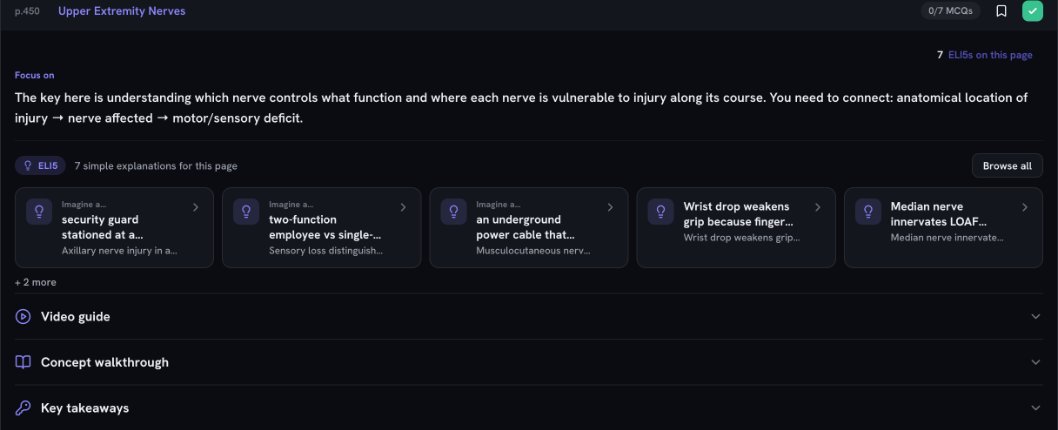
This is what a real MSK page opens with. Page 450, upper extremity nerves, Focus On:
Focus On, p. 450: "The key here is understanding which nerve controls what function and where each nerve is vulnerable to injury along its course. You need to connect: anatomical location of injury → nerve affected → motor/sensory deficit."
First Aid p. 450 (Upper extremity nerves) in the First Aid Guide: Focus On, the ELI5s, the video guide, Concept walkthrough, Key takeaways, How is this tested? and Test yourself.
You understand MSK. Now learn how the exam asks it. Mehlman's videos take each high-yield topic and show you which clue rules an answer in and which one rules it out. In MSK that's the nerve-lesion and rheumatology questions, where 2 options look right until you know the 1 clue that separates them.
1
Videos, not PDFs. The value is the reasoning, and the PDFs don't have it.
2
The full MSK playlist, in order. Sort by date and watch the last 3 years first if you're short on time. The walkthrough on how to do this is in the University section of the Vault. Watch it first.
3
Pause before he answers. Answer it yourself. Any gap → open that First Aid Guide page and fix it the same day.
Why: active reading gave you the facts. Active application turns facts into decisions, which is the only thing a UWorld question asks for. How to use Mehlman →
Day 4, second half
Active recall: FA Foundation Anki, MSK
The FA Foundation Anki deck is First Aid, page by page, 1 high-yield point per card, with the First Aid page number on every card. The MSK deck is 136 cards (as of October 2026): about 93 on the MSK pages and 43 on the derm pages.
1
Run the whole deck this afternoon, all 136 cards. The derm cards are an early pass; you run them again in the derm block. Answer before you flip. Recognising a line and pulling it out of memory are different skills, and UWorld tests the second one.
2
Hesitate → open the page. Go to that page number in the First Aid Guide, read the line and a couple above and below, then go back to the card.
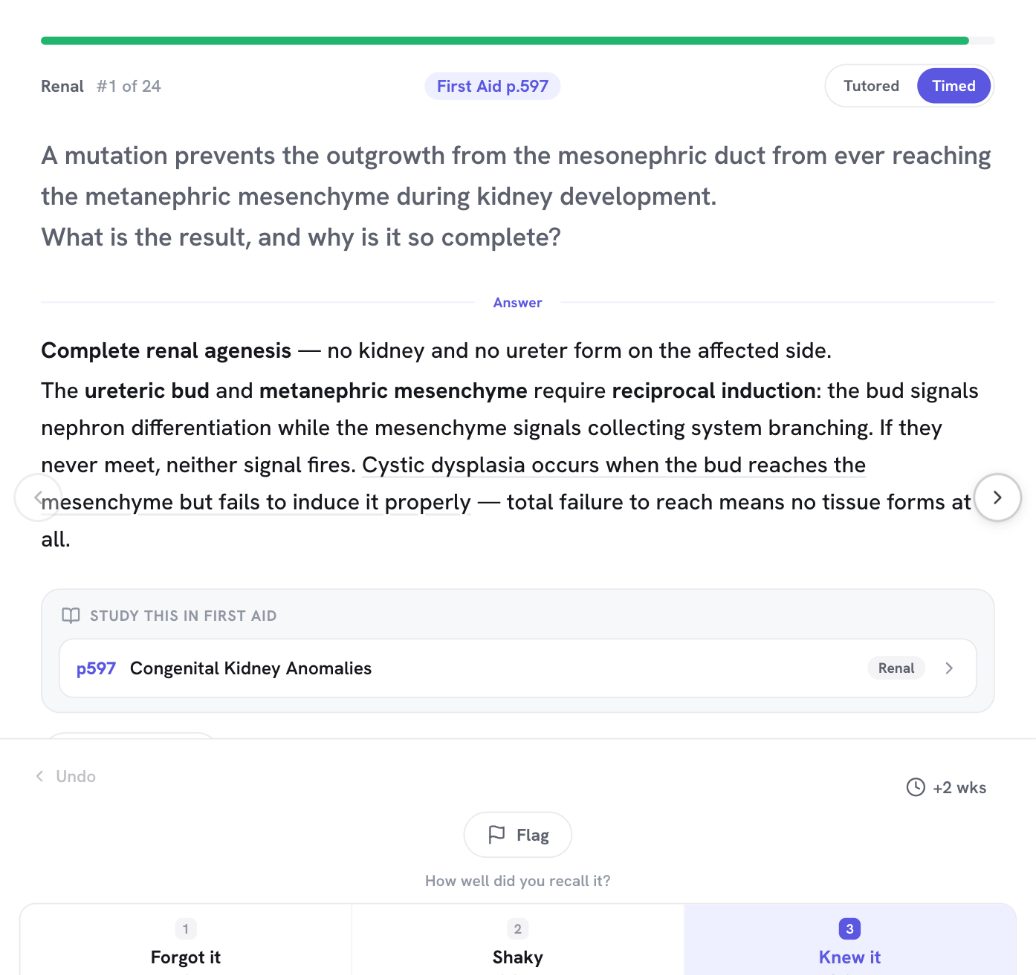
A FA Foundation Anki card (renal shown), flipped: First Aid p. 597 on the card, and “Study this in First Aid” under the answer. The MSK deck works the same way.
Run the FA Foundation Anki · MSK deck136 cards (as of October 2026), First Aid page by page, with the page number on every card. Opens straight into the deck.
Now you open UWorld. You're not meeting MSK here. You're proving you already own it.
Setting
Choose
Questions
Unused
Subjects
All
Systems
Musculoskeletal only (skin is a separate system; leave it for derm)
Mode
Tutor, untimed
Block size
20 questions
S
Solve. 2 blocks of 20. Bookmark every question you got wrong and every one you got right by guessing.
R
Review in First Aid. For each bookmark, find the exact First Aid line it came from, highlight it, read a couple of lines around it. 5–6 minutes a question at most. Then the next 2 blocks.
Target:65% or above. If your last 2 blocks are under 60%, go back to the Mehlman videos for those topics, then the First Aid pages behind them.
MSK is finished when every MSK question is attempted, every miss is traced to its First Aid page, and your last 2 blocks held above 65%. Not when a date passes. MSK has about 280 UWorld questions on the Vault schedule: 14 blocks, 6 a day on Days 5–6, and the last 2 the next morning. When is a system actually finished? → · The full RPSR method →
Later, for your NBMEs: NBME Booster Anki · MSKThe MSK questions from retired NBME forms 20 to 34 and the Free 120, as cards. Not for now: open it when your NBME phase starts. What the Booster is →
Derm is its own short block of 3 days, after MSK (the Vault schedule builds it in 3 days at 10–12 hours). First Aid pp. 481–494, 57 MCQs. Same order, smaller: the 7 derm organisms (Staphylococcus, Streptococcus, HSV, VZV, HPV, molluscum contagiosum, HHV-6) → active reading of pp. 481–494 → the Mehlman dermatology playlist → the derm Anki cards → UWorld skin.
Open Derm Micro →▶Mehlman Medical · Dermatology playlistActive application for derm.
Where MSK sits
MSK opens the neuro block: MSK, then psychiatry, then ANS, then neurology. They share pathways, drugs and anatomy, so done together they reinforce each other. MSK → psychiatry is a fixed order. Next: Psychiatry in 5 days → · later: Neurology in 7 days →
What not to do
Do not mix derm into MSK. 2 subjects in 1 week means neither sticks.
Do not open UWorld on Day 1. You'll score 40%, decide you're bad at MSK, and you're simply in the wrong order.
Do not read First Aid to memorise it. Days 2–3 are for understanding.
Do not skip the page MCQs. If you can't answer them, you read the page. You didn't learn it.

 Build my schedule →