These are the mistakes I see every single week, in the order they happen: from day 1 of your prep to the day you pick your exam date.
By Dr. Marish Asudani · Published
What are the biggest mistakes IMGs make in Step 1 prep?
The 10 I see most: starting with biochem or cardio; Boards & Beyond for every system; treating a read of First Aid as a finished system, or saving its questions for random mode; trying to learn First Aid on the first read; Mehlman's PDFs instead of his videos; NBMEs online instead of offline; not reviewing an NBME within 24 hours; attempting Step 1 without consistently scoring above 68% on NBME 31, 32 and 33; never doing a full-length 14-block assessment; and having no proper schedule.
Read this firstEvery IMG who comes to me has made at least 3 of these. Most have made 5. I made a few of them myself.
The good news is that none of them are about how smart you are. Each one has a plain fix. Read the ones you recognise, open the link next to it, and fix that one thing first.
All 10 mistakes are on this page, one after the other. Jump to a phase:
1 to 5 happen while you're learning the systems. 6 to 10 happen once the NBMEs start.
Content phase · mistakes 1–5
1
Beginning with biochemistry or cardiovascular, thinking they're important
99% of IMGs begin with biochemistry, and then they quit, because biochemistry is just that difficult. The rest open cardio because it feels like the big one. Open your First Aid: it tells you cardio is not one of the most important systems.
The fix:micro and pharm first, because they're roughly 20 to 30% of your exam. Then renal, because it's easy and builds momentum. Cardio comes last. Biochem goes in 7 small pieces, each one right before the system that needs it.
Boards & Beyond was the go-to a few years ago, and the teaching is good. The problem is that none of it is anchored to First Aid. You end up with slides and a book and no idea which one to annotate, and 3 hours of videos a day that don't move your UWorld.
The fix: Boards & Beyond is not a necessity. Each system goes: its micro and pharm, then First Aid with the First Aid Guide → Mehlman → FA Foundation Anki → UWorld.
Thinking that reading First Aid means the system is finished
You read 33 pages of renal, close the book, and tick renal off. Reading is the first of 4 steps: you understand it, then apply it, then recall it, then test it.
And the half-finished version of this mistake: leaving some of that system's MCQs for random mode later. If you do that, you never complete the system. Those questions come back at the end, the topics in them are new because you never did them, your scores drop, and you decide UWorld isn't useful at all.
The fix: a system is finished on evidence: every UWorld question done, system-wise (unused · your system only · tutor · untimed · blocks of 20, at least 2 blocks a day), every bookmark traced to its First Aid page, the last 2 blocks above 65 to 70%, the FA Foundation Anki cleared, and the last block felt boring.
Each system's own guide, in the order you do them:
Start the free 3-day trial: the Vault tells you what to do nextYour schedule opens on today's task: which First Aid pages, which Anki deck, which UWorld blocks, and when a system is finished. No card needed.
Trying to learn First Aid in the first read itself
You open First Aid and try to learn every line on the first read. You spend 5 to 6 days learning First Aid, and at the end of it you still can't apply anything to a question.
The fix: you're not supposed to learn First Aid on the first go. The first read is for understanding, with the First Aid Guide beside you. Then you apply it with Mehlman and the questions, and you recall it with the FA Foundation Anki. The learning happens on those passes, not on the first.
Read renal with the First Aid Guide, freePage by page, with what to understand on each page and that page's MCQs. Renal is free in the Vault.
The PDFs are chunky and there's no repetition in them. In the videos, he repeats the high-yield points until they stick, and he teaches you how the NBME thinks: how the stem is built, how the options are built, and how to rule out every option.
The fix:the videos, the full system playlist, in order, as a fixed step in every system.
The online version gives you 50 questions in 75 minutes. It feels comfortable, and it inflates your score by about 4 to 6%. You end up picking a date on a number that was never real.
The fix:offline, always. 10 blocks of 20 questions, 30 minutes each, which is the pace of the real exam. First pass in about 23 to 24 minutes a block, and a 5 to 6 minute break every 2 blocks. About 40 to 45 minutes of breaks in total is right for a 10-block NBME. The rest of your break time is still there on exam day, because the real exam is 14 blocks.
Not reviewing an NBME within 24 hours of taking it
You read the score, feel something, and start the next form. Today you still remember why you picked each wrong option. After 24 hours, that reasoning is gone. A form you don't review is a diagnosis you've paid for twice.
The fix:review the same day. Every incorrect classified, understood and written down as 1 line, filed by system.
Picking your exam date, or attempting Step 1, without 68%+ on NBME 31, 32 and 33
⭐ MOST EXPENSIVE
Only 3 forms carry a verdict: NBME 31, 32 and 33. And the trend beats the number. If you're stuck at 63, 64, 65 and 1 form spikes to 71, that spike is noise, and it's the most common reason people book their exam too early.
The fix: give or attempt Step 1 only when you're above 68% on all 3 of NBME 31, 32 and 33, and finishing your blocks with time left over.
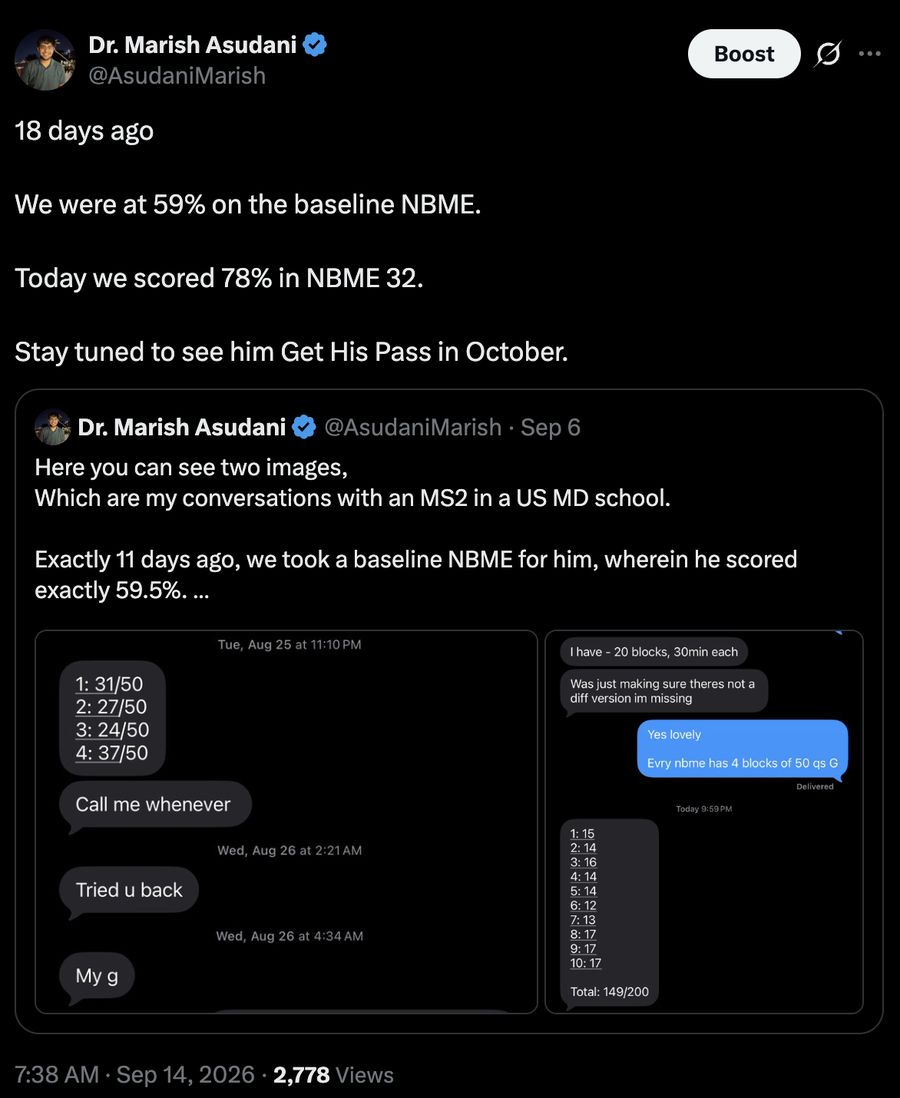
My tweet, Sep 14, 2026: 59% on the baseline to 78% on NBME 32. His full schedule →
Keep a hard date in your mind from day 1. That keeps you studying hard. But don't give the exam, or lock the date, until the trend on 31, 32 and 33 says you're ready. And every one of those forms is taken offline.
The real exam is a full day. If the longest thing you've ever given is 1 NBME, the last 4 blocks of the real exam feel endless, and that's where tired mistakes happen.
The fix: in your last month, give a full 14-block assessment, so the real exam feels short. Take the Vault assessment → 14 blocks, 280 questions, and Assessment 2 is free.
Give the Vault Assessment14 blocks of 20, 280 questions, stems at real-exam length, with a system-by-system report and an honest pass verdict. Assessment 2 is free for every signed-in student.
Without a schedule, every morning starts with deciding what to do. You lose an hour deciding, you pick what feels comfortable, and the hard systems keep moving to next week.
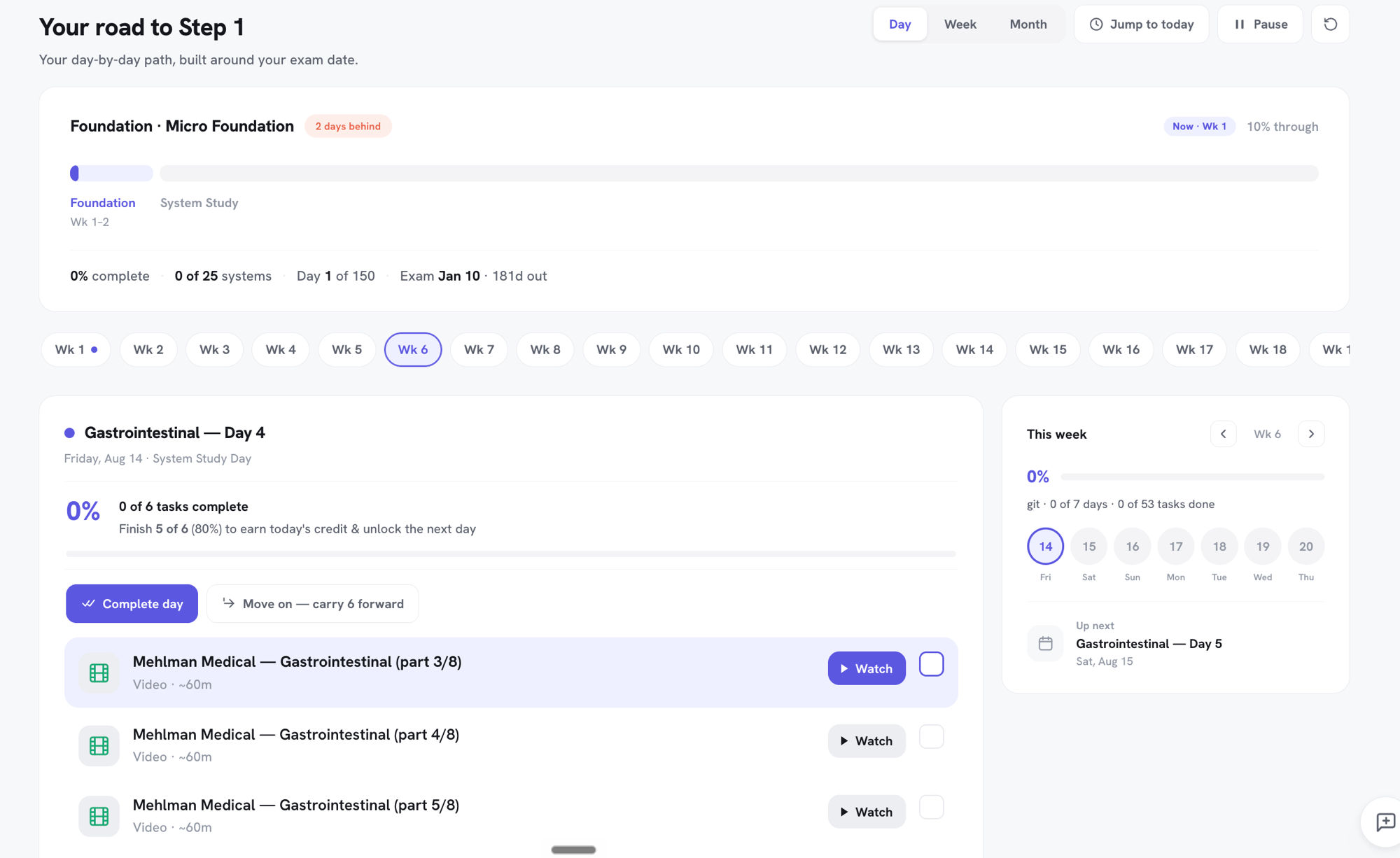
The fix: a day-by-day plan built from your exam date and your hours, so every one of the 9 fixes above is already in it.